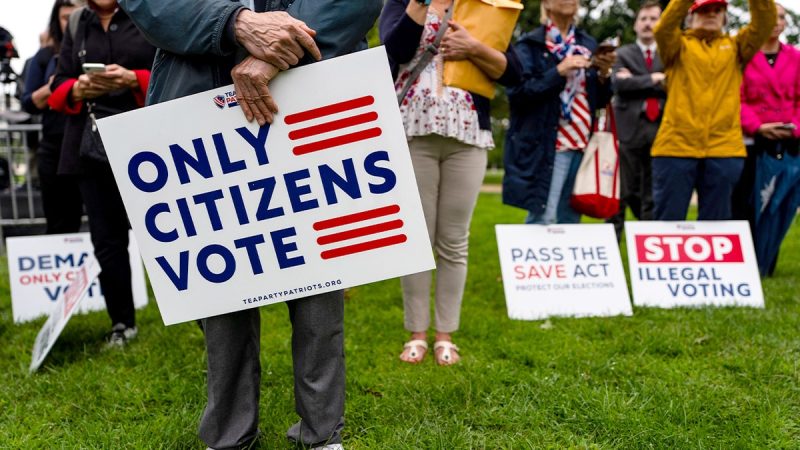
Arguing that noncitizens could be on state voter rolls — something that is illegal under federal law — the Trump administration is escalating its campaign to obtain registration data ahead of the 2026 midterms, despite a string of federal court setbacks.
The strategy has unfolded on three fronts: cooperation from Republican-led states willing to share voter data, lawsuits against roughly two dozen blue and purple states that have refused, and a legislative push in Congress to tighten national voting requirements. Federal judges have so far rebuffed the administration’s legal demands, but the Justice Department is widening its campaign as Election Day draws near.
Hans von Spakovsky, a senior legal fellow at the conservative group Advancing American Freedom, said voter rolls are a central focus ahead of the midterms because of the Trump administration’s concerns that noncitizens are on them and could end up voting. It is illegal for noncitizens to vote in federal elections.
‘The problem is, blue states, like Oregon, they have no interest in that kind of verification, so they’re not actually doing what they ought to be doing, which is running data-based comparisons with the [Department of Homeland Security],’ von Spakovsky told Fox News Digital.
The DOJ has made sweeping demands for not just publicly available voter roll data, but also sensitive information, such as voters’ partial Social Security numbers and dates of birth.
The latest state to successfully fight the DOJ’s request is Michigan, where Secretary of State Jocelyn Benson said the federal government was not entitled to its 7 million voters’ personal information beyond what was already available.
The DOJ cited three federal laws, the Civil Rights Act, the Help America Vote Act and the National Voter Registration Act, that it said gave the Trump administration the right to the confidential information. Judge Hala Jarbou disagreed.
‘The Court concludes that (1) HAVA does not require the disclosure of any records, (2) the NVRA does not require the disclosure of voter registration lists because they are not records concerning the implementation of list maintenance procedures, and (3) the CRA does not require the disclosure of voter registration lists because they are not documents that come into the possession of election officials,’ Jarbou, a Trump appointee wrote.
Federal judges in Oregon and California have also thrown out the DOJ’s lawsuits. The DOJ could appeal the decisions. A department spokesperson declined to comment for this story.
But the DOJ has seen cooperation from red states, such as Texas, Alabama and Mississippi, who were among several to reach a ‘Memorandum of Understanding’ that led the states to hand over the information the department wanted.
In another maneuver, Attorney General Pam Bondi pressured Minnesota Gov. Tim Walz, a Democrat, to provide the Midwest battleground’s voter rolls, saying in a warning letter that such action would help ease unrest in the state that stemmed from a federal immigration crackdown there.
Democrats were enraged by the letter and have argued the Trump administration is infringing on states’ rights to conduct their own elections.
Sen. Chris Murphy, D-Ct., argued the letter was a ‘pretext for Trump to take over elections in swing states,’ while a state lawyer described the letter as a ‘ransom note.’ The DOJ, at the time, told Fox News Digital Democrats were ‘shamelessly lying’ about the letter’s purpose. Bondi said that handing over the voter rolls was among several ‘simple steps’ Minnesota could take to ‘bring back law and order.’ A lawsuit is still pending in Minnesota over the voter rolls.
In Congress, the Safeguard American Voter Eligibility Act would make it a national requirement that people registering to vote provide in-person proof of citizenship, such as birth certificates or passports. The legislation also includes a new national requirement for photo ID at the polls.
The bill has widespread Republican support. The House passed the SAVE Act last week, and even moderate Republican senators like Sen. Susan Collins, R-Me., have said they are on board with it. The bill is still stalled in the Senate, however, because it needs 60 votes to pass, meaning several Democrats would need to support it. Currently, none do.
Von Spakovsky noted that the SAVE Act had a key provision that would allow private citizens to bring lawsuits over it.
‘There’s no question in my mind that if the Save Act gets passed, there are election officials in blue states that will be reluctant to or may refuse to enforce the proof of citizenship requirement,’ von Spakovsky said. ‘The Save Act provides a private right of action, so that means that citizens in Oregon could sue those election officials if they’re refusing to comply with the Save Act.’
He said the private right of action provision would also provide recourse for citizens if Democrats take over the DOJ in the next administration and refuse to enforce the SAVE Act.
Trump has repeatedly argued that noncitizen voting poses a threat to election integrity and has pressed Republican lawmakers to tighten federal requirements. Last week, he floated attempting to impose identification requirements through executive order if Congress does not act.
‘This is an issue that must be fought, and must be fought, NOW!’ Trump wrote on Truth Social. ‘If we can’t get it through Congress, there are Legal reasons why this SCAM is not permitted. I will be presenting them shortly, in the form of an Executive Order.’
A much broader bill called the Make Elections Great Again Act is still moving through the House and faces a steeper uphill climb to passage.
In addition to national documented proof of citizenship requirement, the MEGA Act would end universal mail voting, eliminate ranked-choice voting and ban ballots postmarked by Election Day from being accepted after that day, which would outlaw postmark rules in 14 states and Washington, D.C.
This post appeared first on FOX NEWS