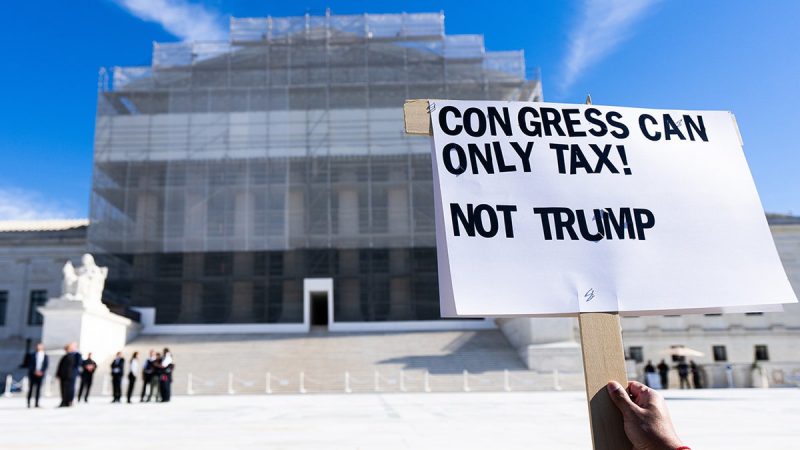
The Supreme Court rebuked President Trump’s use of the International Emergency Economic Powers Act to impose sweeping ‘Liberation Day’ tariffs, ruling that the Constitution gives Congress — not the president — authority over tariffs.
But the decision may not be the final word. From the Trade Expansion Act to the Trade Act of 1974 and even Depression-era statutes, multiple legal avenues remain that could allow Trump to reassert aggressive trade powers.
In a 6-3 decision led by George W. Bush-appointed Chief Justice John Roberts, the court ruled that the ‘framers gave [tariff] power to Congress alone, notwithstanding the obvious foreign affairs implications of tariffs.’
George H.W. Bush-appointed Justice Clarence Thomas, Trump-appointed Justice Brett Kavanaugh and George W. Bush-appointed Justice Samuel Alito dissented.
On ‘Liberation Day’ in 2025, Trump cited the International Emergency Economic Powers Act (IEEPA), drafted by former Rep. Jonathan Brewster-Bingham, D-N.Y., to declare an emergency situation in which foreign countries were ‘ripping off’ the U.S.
With that avenue now closed by Roberts, Trump could try to use the same national security rationale to invoke the Trade Expansion Act of 1962, which in part allows the Commerce Department to impose tariffs on ‘article[s]… imported… in such quantities or under such circumstances as to threaten or impair the national security.’
Unlike the IEEPA, the JFK-era law has been tested in the courts, and Commerce Secretary Howard Lutnick has since built on his predecessor Wilbur Ross’ 2018 steel and aluminum tariffs imposed under the act, adding 407 more imports to the tariff list on the grounds that they are ‘derivative’ of the two approved metals.
During his 2025 confirmation hearing, Lutnick voiced support for a ‘country by country, macro’ approach to tariffs and agreed with the president that the U.S. is ‘treated horribly by the global trading environment.’
While tariffs imposed under Section 232 of the Trade Expansion Act are not immediate and require the Commerce Department to conduct a formal investigation, the law provides a court-tested avenue for the president.
In the wake of Friday’s ruling, Sen. Rand Paul, R-Ky., and others celebrated the court’s affirmation that Trump cannot use ’emergency powers to enact taxes,’ but Congress has previously approved another avenue to impose tariffs.
Then-Rep. Albert Ullman, D-Ore., crafted a bill signed by President Gerald Ford that expressly gave presidents broader authority to impose tariffs: the Trade Act of 1974.
A federal appeals court in September ruled against thousands of companies that challenged tariffs on China imposed under Section 301 of the Trade Act.